Acne Marks vs Acne Scars: How to Tell the Difference
Acne Marks vs Acne Scars: How to Tell the Difference
You had a breakout. The pimple is gone. But you’re still left with something on your skin.
Maybe it’s a brown or reddish spot.
Or maybe you can actually feel a small dip when you run your finger over the area.
Those two things can look similar in a mirror, but acne marks vs acne scars is an important distinction because they aren’t the same problem and may not need the same treatment.
This is one of the first things a dermatologist looks at when someone comes in asking how to get rid of “acne scars.”
What Is the Difference Between an Acne Mark and an Acne Scar?
The simplest way to think about it is this:
An acne mark is mainly a change in colour.
An acne scar is a change in the structure or texture of the skin.
A flat brown spot left after a pimple may be post-inflammatory hyperpigmentation.
A depressed area that looks like a small indentation is more likely to be an atrophic acne scar.
The American Academy of Dermatology explains that acne scars can develop after deeper acne lesions and that different scar types require different approaches.
What Do Acne Marks Look Like?
Acne marks are usually flat.
You may see:
- Brown spots
- Darker patches
- Red or pink areas
- Uneven skin tone around previous breakouts
If you close your eyes and run your fingers gently over the skin, the surface may feel relatively smooth even though the colour is different.
That’s a useful clue.
A mark doesn’t necessarily mean the skin has developed a permanent depression.
What Do Acne Scars Look Like?
Scars affect the structure of the skin.
They may appear as:
- Small pits
- Wider depressions
- Uneven texture
- Rolling indentations
- Narrow, deeper openings
- Raised areas
The AAD describes different types of depressed acne scars, including ice-pick, rolling and boxcar scars. These can require different treatments.
This is why there isn’t one universal “acne scar treatment.”
A Quick Test: Look and Feel
If you’re trying to understand acne marks vs acne scars, don’t just look at your face under bright light.
Feel the skin gently.
If the area is flat but darker, you’re more likely looking at pigmentation.
If you can see or feel an indentation, texture change or raised area, it may be a scar.
Of course, this isn’t a medical diagnosis.
Lighting can make mild texture look much worse, and several different concerns can exist together.
Can You Have Both?
Yes — and this is actually quite common.
You might have an old pimple that left:
- A brown mark
- A shallow depressed scar
- Uneven texture
all in the same area.
That’s why a dermatologist may recommend different treatments for different parts of the skin.
The AAD notes that acne scar treatment is tailored according to scar type, skin tone and other individual factors, and more than one treatment may sometimes be used.
Why Do Acne Marks Happen?
When acne becomes inflamed, the skin can respond by producing more pigment.
After the acne settles, the colour may remain even though the pimple itself has disappeared.
Sun exposure can also make pigmentation more noticeable.
That’s one reason sunscreen becomes an important part of managing post-acne pigmentation.
If you’re still developing new acne, treating the active acne matters too. Otherwise, you’re trying to fade old marks while new ones continue to appear.
Why Do Acne Scars Form?
Scars are more likely when inflammation damages the deeper structures of the skin.
Not every pimple produces a scar.
Deep, inflammatory acne is more likely to leave permanent textural changes.
The AAD notes that acne scars can form after deeper breakouts and that treating acne early can help reduce the risk of scarring.
This is one reason squeezing painful pimples isn’t a good strategy.
Can Acne Marks Disappear on Their Own?
Some can fade over time.
How quickly depends on the type of pigmentation, your skin tone, sun exposure and whether new acne continues to occur.
That doesn’t mean you have to simply wait.
A dermatologist can assess whether you’re dealing with post-inflammatory pigmentation and determine whether treatment is appropriate.
The important thing is to identify the concern correctly first.
Do Acne Scars Go Away on Their Own?
True acne scars are different.
They may become less noticeable over time, but many depressed acne scars don’t completely disappear without treatment.
This is where professional assessment becomes useful.
A treatment that helps pigmentation isn’t necessarily going to correct a depressed scar.
And a procedure designed to improve scar texture isn’t necessarily the first choice for a flat brown mark.
What Treatments Are Used for Acne Scars?
Treatment depends heavily on the scar type.
A dermatologist may consider options such as:
- Microneedling
- MNRF / radiofrequency microneedling
- Chemical peels
- Laser treatments
- Subcision
- Fillers in selected cases
- Combination approaches
The AAD notes that microneedling, radiofrequency microneedling, laser treatments and other procedures can be used for selected acne scars, with treatment chosen according to the scar and individual patient factors.
Misskin currently offers Acne Scar Treatment in Bangalore using options such as microneedling/MNRF, subcision, lasers and peels depending on the scar type.
Where Does MNRF Fit In?
MNRF stands for microneedling radiofrequency.
It combines controlled microneedling with radiofrequency energy.
The idea is to stimulate collagen remodelling at different depths.
Misskin’s Microneedling & MNRF treatment is used for concerns including acne scars, enlarged-looking pores, uneven texture and early skin ageing. The clinic describes treatment depth as being selected according to the patient’s skin and concern.
The important point is that MNRF isn’t automatically the right answer for every scar.
What About Microneedling?
Microneedling creates controlled micro-injuries in the skin to stimulate collagen production.
The AAD describes it as a treatment that can help improve acne scars, uneven texture, enlarged-looking pores and other concerns.
It’s also worth knowing that microneedling isn’t appropriate for every situation.
The AAD advises waiting if someone has certain active skin conditions, infections, significant inflammatory pimples or a recent tan, among other situations.
That’s another reason professional assessment matters.
What If You Still Have Active Acne?
Treating scars while significant active acne is still uncontrolled may not be the first priority.
Why?
Because new breakouts can create new marks and scars.
The AAD notes that acne scar treatment commonly begins after active acne is brought under control.
So your dermatologist may first focus on reducing breakouts before moving on to procedures for texture.
This can feel slower, but it makes sense when the goal is long-term improvement rather than simply treating what’s visible today.
Can Chemical Peels Help Acne Marks?
Chemical peels can be used in selected patients to address pigmentation and certain acne-related concerns.
But the type and strength of peel matter.
A peel isn’t simply something you choose based on a social-media recommendation.
Your dermatologist needs to consider:
- Skin tone
- Pigmentation
- Sensitivity
- Active acne
- Previous treatments
- Risk of post-inflammatory pigmentation
Misskin includes Chemical Peels in Bangalore among its dermatologist-led treatment options.
Why Indian Skin Needs a Careful Treatment Plan
This is particularly relevant for patients in Bangalore.
Skin that develops pigmentation easily can respond differently to aggressive procedures.
The treatment needs to balance improvement with the possibility of post-inflammatory pigmentation or irritation.
That doesn’t mean procedures can’t be used.
It means the dermatologist should select the treatment, depth, intensity and spacing according to your skin.
The AAD specifically notes that acne scar treatment planning takes factors such as skin tone into account.
What Should You Do If You Can’t Tell Whether It’s a Mark or Scar?
Take a close look in natural light.
Then ask yourself:
Is it flat?
If yes, pigmentation may be the bigger issue.
Can I feel a depression?
If yes, there may be a textural scar.
Is the area raised?
That may represent a different type of scar altogether.
Am I still getting new acne?
If yes, active acne may need to be addressed first.
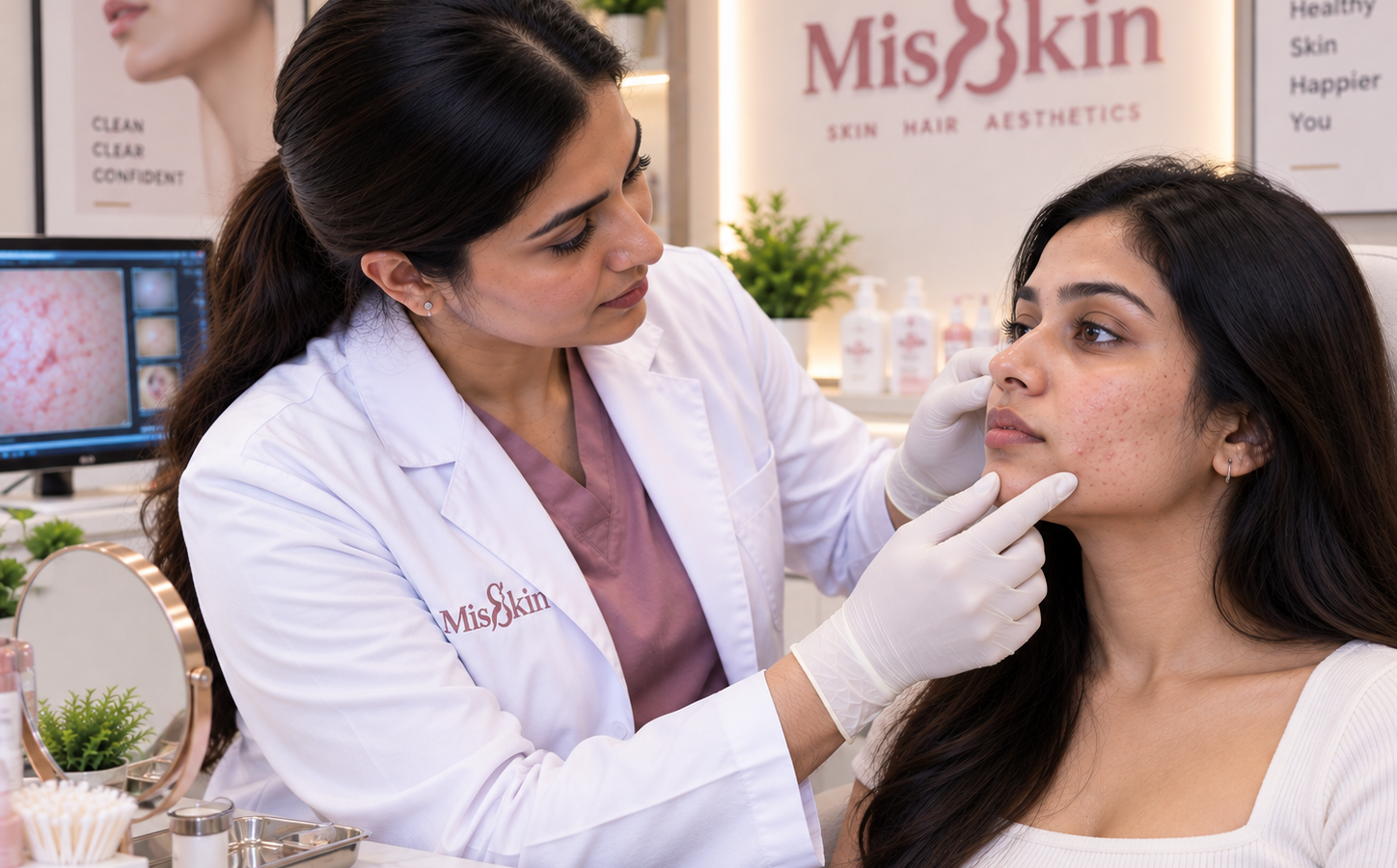
And if you’re still unsure, that’s exactly what a dermatologist consultation is for.
Don’t Choose a Treatment From a Before-and-After Photo Alone
This is probably the most useful advice if you’re researching acne scar treatment online.
You might see an impressive result from MNRF, laser, microneedling or a peel.
But the person in the photograph may have a completely different scar type from yours.
A treatment that works well for rolling scars may not be the appropriate approach for deep ice-pick scars.
The AAD specifically points out that different acne scar types require different treatment approaches.
So instead of asking, “Which treatment is best?”, a better first question is:
“What type of scar do I actually have?”
Frequently Asked Questions
What is the difference between acne marks and acne scars?
Acne marks are generally flat changes in skin colour, while acne scars involve a structural or textural change in the skin.
Do acne marks disappear?
Some acne-related pigmentation can gradually fade, although the timeline varies. Sun protection and appropriate treatment can help manage pigmentation.
Do acne scars go away naturally?
Some scars become less noticeable over time, but true depressed acne scars often don’t completely disappear without treatment.
Is MNRF good for acne scars?
MNRF can be considered for selected acne scars and uneven texture. Whether it is appropriate depends on the scar type, skin condition and individual assessment.
Can microneedling help acne scars?
Yes, microneedling can be used for certain acne scars and works by stimulating collagen production. A dermatologist should determine whether it is suitable for your skin.
Should active acne be treated before acne scars?
Often, yes. Dermatologists commonly address active acne first to reduce new breakouts and prevent additional scarring.
Which acne scar treatment should I choose?
There isn’t one treatment for every scar. A dermatologist should assess whether you have ice-pick, boxcar, rolling, raised scars or primarily pigmentation before recommending a procedure.
The First Step Is Getting the Diagnosis Right
When you’re comparing acne marks vs acne scars, don’t get too caught up in treatment names.
Start with the skin itself.
Is the problem colour? Texture? Both?
Are you still getting acne?
Are the scars shallow or deep?
Once those questions are answered, treatment becomes much more straightforward.
At Misskin, the approach starts with a dermatologist assessment before selecting treatments such as MNRF and microneedling, peels, lasers or other options where appropriate.
Misskin
Dermatologist-led skin and aesthetic care in Bangalore
Locations: Sadashivanagar | RR Nagar | Jayanagar | HSR Layout | HRBR Layout
Call: 9538666485
Email: reachus@misskin.in
Book Your Consultation